Last Updated on March 11, 2026 by Sunny Staff
We talk to the owners of growing businesses every week. They started on large, well-known hosting brands. At first, everything felt simple. Affordable plans. “Unlimited” bandwidth. One-click installs. A friendly mascot. It worked – until it didn’t.
As traffic increased, marketing campaigns ramped up, or WooCommerce entered the picture, the cracks began to show. Slower load times. Plugin conflicts. Backup confusion. Support loops that answered questions but didn’t solve problems.
That’s typically when the hosting conversation changes from “What’s cheapest?” to “Who actually owns my site’s stability?”
The primary difference between HostGator and Sunny HQ is the operational ownership model. HostGator is a commodity infrastructure provider where the user is responsible for site-level maintenance, updates, and performance tuning. Sunny HQ is a concierge-managed WordPress platform that assumes full responsibility for technical health, including proactive security, manual update testing, and performance optimization handled by human engineers.
Key Takeaways
- HostGator is a mass-market hosting provider powering over 2 million websites, known for affordability and accessibility.
- It offers “managed WordPress” plans, but site-level maintenance remains largely self-managed.
- Sunny HQ provides fully managed, concierge WordPress hosting – updates, performance tuning, monitoring, and support handled by humans.
- HostGator works well for early-stage projects, freelancers, or DIY site owners.
- Sunny HQ is built for revenue-generating businesses that need reliability without technical overhead.
First, A Quick Framework: There Are Three Types of Hosting Companies
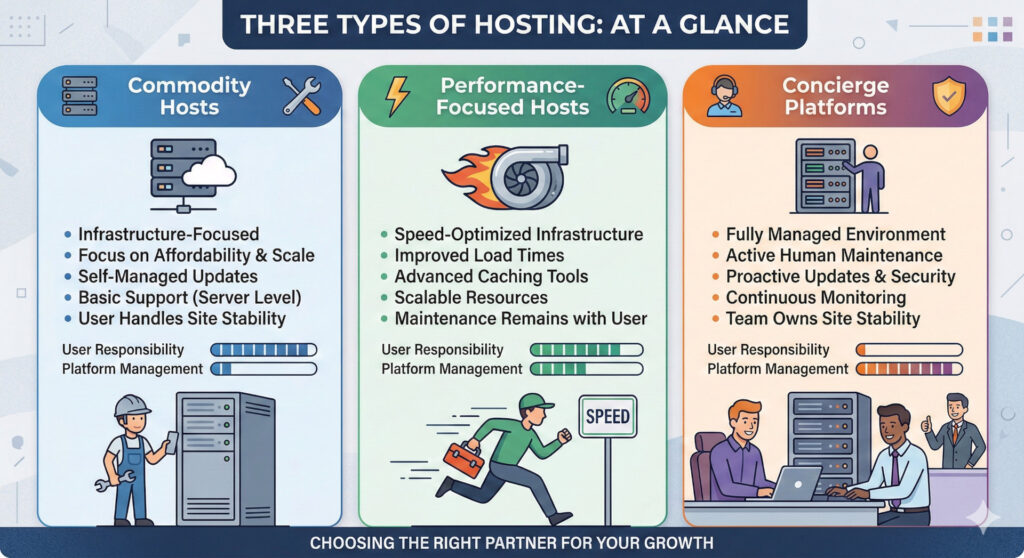
Before comparing features, it helps to define categories. Not all “managed WordPress hosting” is the same.
- Commodity Hosts – Large-scale platforms focused on affordability and scale. You manage most of your WordPress stack yourself. Support helps with hosting, not your site.
- Performance-Focused Hosts – Infrastructure-optimized environments that improve speed but still leave maintenance largely in your hands.
- Concierge Platforms – Fully managed environments where a team actively maintains performance, updates, backups, and site stability.
HostGator sits firmly in the first category: a high-volume, accessible hosting provider designed to scale across millions of websites.
Sunny HQ was built in the third category: a concierge-managed platform where WordPress maintenance and ownership are handled by a dedicated team.
Understanding that distinction changes how you evaluate everything else.
HostGator at a Glance
Founded in 2002, HostGator has grown into one of the most recognizable names in web hosting. With over 2.5 million websites hosted, it operates at massive scale and positions itself as accessible to beginners and professionals alike.
The brand voice is playful and confident. Its messaging emphasizes flexibility, freedom, and 24/7/365 availability. Plans are competitively priced, often marketed with introductory discounts, and structured for broad appeal.
HostGator’s WordPress offering includes:
- Pre-installed WordPress
- Auto-renewed SSL certificates
- Cloudflare CDN integration
- Malware protection options (SiteLock)
- Backup solutions (CodeGuard)
- Phone & chat support
At first glance, it appears comprehensive. And for many early-stage users, it absolutely is.
However, most features operate at the infrastructure level. While the hosting environment is maintained, responsibility for plugin updates, theme conflicts, caching optimization, and performance tuning typically remains with the site owner.
In practice, that works well if you are technically confident or managing a low-risk website. It becomes more complex when revenue, advertising spend, or customer trust is directly tied to performance.
Sunny HQ at a Glance
Sunny HQ was built around a different premise: WordPress hosting should feel calm.
Instead of giving you tools and documentation, Sunny HQ assigns real engineers who actively manage your environment. Updates are applied and tested. Performance is monitored continuously. Security configurations are adjusted per site – not templated across millions of accounts. You still retain admin access and ownership of all your information and files.
This approach is often described internally as Human-First WordPress.
Definition: Sunny HQ’s core philosophy is Human-First WordPress-infrastructure and support designed around real people, real businesses, and predictable outcomes rather than constant tuning and technical overhead. As a standard, 90% of Sunny HQ support requests are fully resolved in two hours or less.
That means:
- Manual plugin and theme updates
- Proactive performance tuning
- Smart multi-layer caching configured per use case
- Verified backups
- Continuous monitoring for uptime and performance degradation
- Direct access to WordPress specialists via phone or email – not generalist call centers or Level 1 gatekeepers
Most importantly, Sunny HQ assumes ownership. If something breaks, the team handles it. If performance drops, they investigate it. If a WooCommerce checkout page needs custom caching rules, they configure it.
It’s less about “hosting space” and more about operational stability.
What “Managed WordPress” Really Means

This is where the comparison becomes important.
HostGator advertises managed WordPress with security tools, backups, and easy setup. And technically, those features are included. WordPress comes pre-installed. Backups can be configured. Malware scans are available.
But here’s what we see frequently when businesses migrate from large hosting brands:
- Plugins auto-updated without compatibility testing.
- Backup systems in place, but restoration procedures unclear.
- CDN enabled, but cache rules not adjusted for eCommerce.
- Security tools active, but performance degraded due to misconfiguration.
None of this means HostGator is broken. It simply reflects scale. At millions of accounts, automation is necessary.
Sunny HQ operates differently. Automation exists – but it’s supervised. Updates are scheduled. Rollback plans are prepared. Core Web Vitals are reviewed regularly. Someone is accountable for performance.
That difference becomes increasingly important as your site transitions from “project” to “business asset.”
Performance & Speed
Speed is rarely a concern when a site is new. It becomes a concern when traffic grows.
For brochure sites or low-volume blogs, HostGator’s infrastructure performs adequately. Their plans include SSD storage, Cloudflare CDN integration, and unmetered bandwidth. WordPress comes pre-installed, and caching can be configured. On paper, that covers the essentials.
Where things shift is under real-world load. eCommerce checkouts. Ad-driven traffic spikes. Dynamic content. Logged-in user sessions. At that stage, performance becomes less about bandwidth and more about configuration.
HostGator provides the tools – but performance tuning remains your responsibility. Cache exclusions for carts. Optimization for WooCommerce fragments. Identifying third-party scripts that stall rendering. These are typically handled by the site owner or developer.
Sunny HQ approaches performance differently. Every site operates inside a performance baseline built at the platform level. That includes:
- Smart multi-layer caching configured per site
- Priority loading of critical content
- Server-level WordPress tuning
- Ongoing monitoring for performance degradation
- CDN configuration aligned with business use case
We often speak with frustrated business owners who were told their host was “fast,” but still struggled with 5-7 second load times during campaigns. In most cases, infrastructure wasn’t the issue – configuration was.
The core difference here is simple: HostGator provides capability. Sunny HQ provides oversight.
Security & Backups
Security is where marketing language and operational reality can diverge.
HostGator includes SSL certificates, malware scanning (via SiteLock), and backup tools like CodeGuard. These are legitimate protections. For many users, they’re sufficient.
However, these tools operate largely as add-ons or automated systems. If malware is detected, remediation often requires additional steps. Backups are available – but verification and restore testing are typically self-managed.
This works well in environments where someone technical is available to intervene. It becomes stressful when business owners assume “security included” means “security handled.”
Sunny HQ treats security as an ongoing responsibility, not a feature checkbox. That includes:
- Manual review of update compatibility before deployment
- Least-privilege access configuration
- Continuous monitoring for anomalies
- Verified backups
- Direct remediation in the rare event of compromise
The goal isn’t just prevention. It’s containment. When something unusual happens, there’s already a team familiar with your stack.
That difference rarely shows up in a feature comparison table – but it becomes very real when revenue is tied to uptime.
Support & Ownership
HostGator advertises 24/7/365 phone and chat support, and they do make themselves widely available. For account issues, billing questions, or general hosting concerns, responses are typically accessible and responsive.
But here’s an important distinction: support is not the same as ownership.
At scale, support teams must triage. They assist. They guide. They document. But they rarely assume long-term responsibility for performance or maintenance.
Sunny HQ operates on a different model. The same engineers who configure your site are the ones who respond when something changes. There’s no tier escalation. No handoff to another department. More than 90% of tickets are resolved within two hours because the team already understands the environment.
We regularly meet business owners who spent days bouncing between chat agents trying to explain why a plugin update broke their checkout flow. That friction disappears when the hosting team already manages updates themselves.
The question becomes: do you want help when things break – or do you want someone preventing them from breaking?
Scalability for Growing Businesses
HostGator’s tiered plans make upgrading straightforward. As traffic grows, you can move from lower plans to higher ones. Storage and bandwidth scale accordingly.
That flexibility is valuable, especially for startups or side projects.
Where scaling becomes more complex is in operational readiness. Increased traffic amplifies every inefficiency: slow queries, bloated plugins, misconfigured caching, and heavy scripts.
Sunny HQ monitors for these pressure points before they become outages. If a campaign is scheduled, environments can be tuned ahead of time. If database strain appears, it’s investigated proactively.
Scaling isn’t just about capacity. It’s about anticipation.
Cost vs Operational Value
HostGator is competitively priced. Introductory offers make it especially attractive for new site owners. For low-risk websites, that pricing makes sense. However, hosts that offer attractive introductory offers close the affordability gap with elevated renewal rates; Hostgator’s renewal rates range from $16.49 to $29.69 or more, depending on which package and addons you choose.
Sunny HQ operates at a premium tier. The pricing reflects active management rather than passive infrastructure.
Here’s where many growing businesses reassess:
- How many hours are spent troubleshooting?
- What does a broken checkout cost per hour?
- How much ad spend is wasted on slow landing pages?
- How many support tickets interrupt your team monthly?
When hosting is evaluated purely as a line item, HostGator often wins.
When hosting is evaluated as operational stability, the math changes.
| Feature Dimension | HostGator (Commodity) | Sunny HQ (Concierge) |
| Who it’s built for | Early-stage projects, freelancers, and DIY site owners. | Revenue-generating businesses, WooCommerce, and agencies. |
| Monthly Cost Range | $5 – $25+ (Standard plans with introductory discounts). | Premium Tier (Reflects active human management). |
| Migration Handling | Automated tools or paid migration services. | Full Concierge Migration handled and verified by engineers. |
| Performance Approach | Infrastructure-based (SSD, CDN) with user-managed tuning. | Application-level optimization with proactive server tuning. |
| Security Model | Reactive: Automated scanning and user-managed fixes. | Proactive: Manual update testing and direct remediation. |
| Support Ownership | Transactional: Assistance with hosting/server issues only. | Operational: Engineers assume ownership of site stability. |
| Support Response | 24/7/365 via generalist chat and phone queues. | Direct Access to WordPress specialists; 90% resolution < 2hrs. |
| Scalability Approach | Tiered plans focused on bandwidth and storage limits. | Anticipatory scaling focused on query and cache efficiency. |
The Bottom Line: HostGator is a line-item expense. Sunny HQ is an insurance policy for your revenue. When hosting is evaluated as operational stability rather than just “server space,” the premium for a concierge service usually pays for itself in a single avoided outage.
Who Should Choose Which Platform?

HostGator Is Likely a Good Fit If:
- You are in the “Launch & Learn” phase: You need an affordable sandbox to test an idea without the pressure of a high monthly overhead.
- Your revenue is not “Live-Dependent”: A few hours of downtime or a slow-loading page won’t result in immediate financial loss or “cart abandonment” during a high-stakes campaign.
- You have the “DIY” bandwidth: You are comfortable manually managing plugin updates, troubleshooting PHP errors, and spending time in support queues to keep costs at a minimum.
- You prioritize low-cost infrastructure over engineering support: You view hosting as a utility (like electricity) rather than an operational partnership that actively protects your time.
Sunny HQ Is Likely a Better Fit If:
- Downtime equals “Dead Air”: You run seasonal promotions, paid ad campaigns, or product launches where even ten minutes of a “500 Internal Server Error” means wasted ad spend and lost customers.
- You’ve outgrown “The Update Roulette”: You are tired of clicking “Update” on a plugin and crossing your fingers that it doesn’t break your checkout page or contact forms.
- Your team is at “Technical Capacity”: You need to offload the “maintenance grind” (security patches, performance tuning, and database optimization) so your team can focus on growth rather than “fixing the site.”
- You require “Zero-Friction” Scaling: You need a platform that anticipates traffic spikes (like a Black Friday surge or a viral press mention) and scales resources before the site crashes, not after.
If you’re running a hobby site, HostGator may be perfectly sufficient.
If you’re running a growing business, the conversation shifts from “Can it host my site?” to “Can I rely on this platform when growth accelerates?”
The Bottom Line: Which Hosting is Better?
HostGator is the superior choice for hobbyists, early-stage startups, and DIY developers who prioritize low-cost infrastructure and are comfortable managing their own site maintenance. However, for revenue-generating businesses where uptime is mission-critical, Sunny HQ is the better investment, providing a concierge-managed partnership that assumes full responsibility for WordPress stability, security, and peak performance.
Conclusion: Hosting Should Get Out of Your Way

The decision between HostGator and Sunny HQ isn’t about which server is faster or which dashboard is prettier. It’s a decision about your time. If you are in a season where you have more time than capital, HostGator is a world-class utility that will help you get your ideas online for the price of a sandwich.
But if your business has reached the point where a broken plugin, a slow checkout page, or a “support ticket loop” costs you more in lost revenue and stress than the price of a premium subscription, then you’ve outgrown commodity hosting. You don’t need a “host” anymore; you need an operational partner: Explore Sunny HQ’s concierge-managed WordPress hosting.
FAQ: Sunny HQ vs HostGator
Is HostGator good for WordPress?
Yes, HostGator is a reliable entry-level solution for standard WordPress sites. It provides an intuitive, one-click installation process, a modern dashboard, and 24/7 support that is well-suited for beginners, hobbyists, and low-traffic blogs. However, because it is a commodity host, users are responsible for their own site-level maintenance, plugin updates, and performance optimization. It is an ideal starting point for those prioritizing affordability over managed stability.
What is the difference between HostGator and Sunny HQ?
The primary difference is the support ownership model. HostGator provides a transactional service where support is limited to server-side and billing issues, leaving WordPress application management to the user. Sunny HQ provides an operational partnership where a dedicated team of engineers assumes responsibility for the site’s stability, including proactive security, manual update testing, and performance tuning.
Does Sunny HQ migrate sites from HostGator?
Yes, Sunny HQ provides a full-service concierge migration for all HostGator accounts. Unlike automated tools that can break complex configurations, Sunny HQ engineers manually handle the transfer, including database optimization and post-launch verification. This process is designed to eliminate downtime and ensure that your site is performance-ready the moment it goes live on the new infrastructure.
How fast is Sunny HQ’s support compared to HostGator?
Sunny HQ operates on a 2-hour resolution standard, whereas HostGator follows a traditional queue-based model. While HostGator offers 24/7 availability, users often experience tiered escalations and “support loops” for complex WordPress issues. In contrast, Sunny HQ has a verified operating metric where 90% of support requests are fully resolved in two hours or less by direct access to WordPress specialists.
Is Sunny HQ more expensive than HostGator?
Yes, Sunny HQ is a premium service designed for revenue-generating businesses. While HostGator focuses on high-volume, low-cost infrastructure starting at a few dollars per month, Sunny HQ’s pricing reflects the cost of active human management and specialized engineering. For businesses where downtime or slow performance results in lost revenue, the “operational value” of Sunny HQ typically offsets the higher subscription cost.